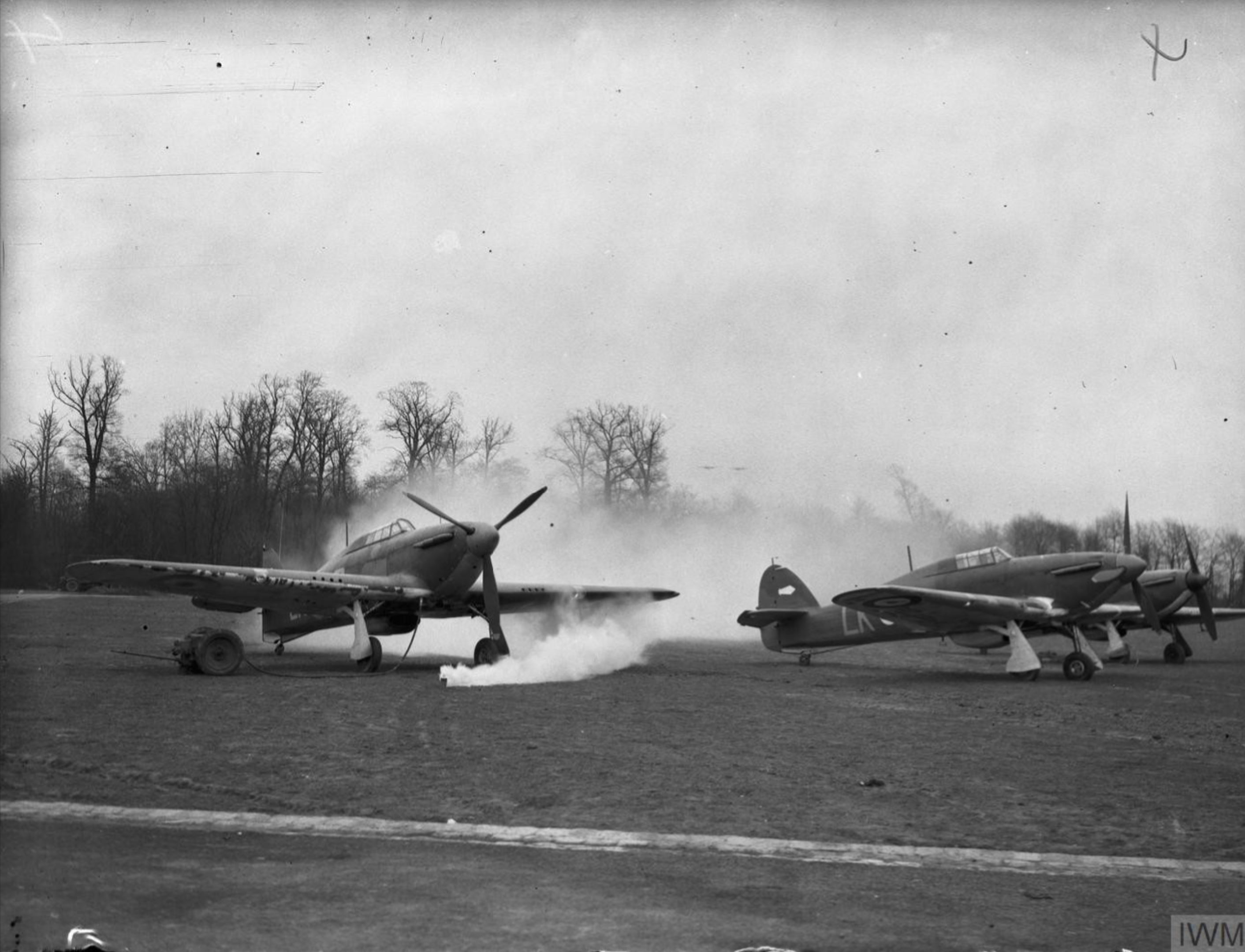
Caption: Hurricane I RAF 87Sqn at Lille Seclin Nov 1939 IWM C468
Caption: Hurricane I RAF 87Sqn simulating a attack Lille Seclin France Mar 1940 IWM C1152
RAF No 87 (United Provinces) SquadronRAF No 87 (United Provinces) Squadron
Motto: Maximus me Metuit (The most powerful fear me)
Formed at Upavon from 'D' Squadron of the CFS on 1 September 1917, it was equipped with Avro 504Ks, Pups and SE5As for training. Dolphins began to arrive in December and it was these which the squadron took to the Western Front in April 1918. I t flew fighter and ground attack operations until the end of the war and returned to Ternhill in February 1919, where it disbanded on 24 June.
The squadron reformed, again in the fighter role on 15 March 1937 at Tangmere. It was equipped with Furies initially, but in June Gladiators began to replace these, whilst at the same time the squadron moved to Debden. Conversion to Hurricanes began in July 1938 and on the outbreak of war the squadron was dispatched to France as part of the Air Component of the BEF. Following the German invasion the squadron was heavily involved in air action for the next two weeks, but then needed to be withdrawn to recuperate and re-equip.
Re-equipment took place at Church Fenton and in July the squadron returned to the South-West where it carried out both day and night patrols as part of no 10 Group. It gradually began to concentrate on night operations and these were extended to night intruder sorties from March 1941 and these continued until November 1942. At this point the squadron was detached to Gibraltar to support 'Operation Torch', the Allied landings in North Africa. It continued to provide defensive cover for the 1st Army throughout the North African campaign.
Spitfires replaced the Hurricanes in April 1943 and in September it moved to Sicily. In January 1944 the squadron operated detachments from Italy from where it carried out fighter sweeps over the Balkans. The squadron re-located to the Italian mainland in June and from the following August it began to conduct fighter-bomber operations. These were maintained until the end of the war, after which the squadron remained as part of the occupation forces until disbanding Tissano on 30 December 1946.
The squadron number was briefly activated when it was linked with No 56 Squadron from 11 February 1949 to 31 December 1951. The squadron being reformed the following day at Wahn in the night fighter role. It was equipped with Meteor NF Mk 11s and these where operated until December 1957, although Javelins had begun to arrive in August. However, on 3 January 1961 the squadron disbanded for the final time.
Squadron Codes used: - PD Oct 1938 - Sep 1939 | LK Sep 1939 - Dec 1946 | B Jan 1952 - Jan 1961
No. 87 Squadron RAF was an aircraft squadron of the Royal Air Force during the First World War and Second World War.
World War I
Notable pilots
Charles J.W. Darwin
Herbert Larkin
Arthur Vigers
World War II
87 Squadron Royal Flying Corps (RFC) was first formed on 1 September 1917 at Upavon from elements of the Central Flying School. On 17 December 1917, it moved to Hounslow Heath Aerodrome and was equipped predominantly with Sopwith Dolphins and Sopwith Scouts, moving on to France in April 1918. After the armistice, the squadron moved back to England and was disbanded at RAF Ternhill on 24 June 1919. The squadron had seven aces, in Arthur Vigers DFC, Leslie Hollinghurst, Henry Biziou, Joseph Callaghan, Charles Darwin, Herbert Joseph Larkin, Alexander Pentland, and Charles Edward Worthington. The squadron's "lazy-S" style insignia in use late in World War I on its Dolphins is said to have been authorised for use by CO Callaghan, whose pre-war time living in Texas, where livestock branding on ranch livestock was common there at that time, could have inspired his choice of squadron insignia.
World War II
Notable pilots
Geoffrey Allard
Roland Beamont
John Cock
John Dewar
Ian Gleed DSO DFC
Derek Harland Ward
Denis Smallwood
No. 87 Squadron was re-formed on 15 March 1937 at RAF Tangmere from elements of No. 54 Squadron RAF, operating the Hawker Fury. At the outbreak of the Second World War, the squadron was part of the air element of the British Expeditionary Force in France, equipped with Hawker Hurricanes. Flight Lieutenant Ian Gleed was posted to the squadron as a replacement pilot on 17 May 1940 and became an ace in two days. He took command of the squadron in December 1940 when it was based at RAF Charmy Down.
John Strachey, who later became a member of parliament (MP), served as the intelligence officer for the squadron during the Battle of Britain. On 23 July Flt Lt AWG Le Hardy (Tony) took command before being sent on Special Operations as the Air Liaison Officer to the Military Mission to Marshal Tito on the island of Vis off the Dalmatian coast of Croatia. Squadron Spitfires were deployed to the island in support of the commando forces from the airfield organised by A/Sqn Ldr Le Hardy for operations in support of the partisan forces in the Balkans for which he was decorated with the OBE, the youngest officer to receive that award, aged 21. The airfield became a valuable destination for damaged Allied Aircraft saving many lives.
In July 1944 87 Squadron, now commanded by Squadron Leader Geoffrey Garton, became one of two RAF Squadrons to join No. 8 Wing SAAF (the other being RAF 185 Squadron) and began fighter-bomber operations supporting the fighting in Italy as well as taking part in offensive sweeps across the Balkans from its detached Italian bases. It continued in this role in the Italian Campaign until the end of the war.
The Cold War
87 Squadron was again re-formed as part of the 2nd Tactical Air Force in Germany on 1 January 1952 at RAF Wahn with the Gloster Meteor NF11, with the main tasking being the defence of the Ruhr. After five years it moved to RAF Bruggen, and was equipped with the Gloster Javelin as an all-weather interceptor force until it was disbanded on 3 January 1961.
Aircraft Operated by RAF No. 87 Squadron Dates Aircraft Variant Notes 1917–1919 Sopwith Dolphin Single-engined piston biplane fighter 1937-1937 Hawker Fury II Single-engined piston biplane fighter 1937–1938 Gloster Gladiator I Single-engined piston biplane fighter 1938–1942 Hawker Hurricane I Single-engined piston monoplane fighter 1941–1944 Hawker Hurricane IIC 1943–1944 Supermarine Spitfire IX, VB, VC VIII Single-engined piston monoplane fighter 1944–1946 Supermarine Spitfire IX 1952–1957 Gloster Meteor NF11 Twin-engined jet night fighter 1957–1961 Gloster Javelin FAW1 Twin-engined all weather and night interceptor 1958–1960 Gloster Javelin FAW5 1959–1961 Gloster Javelin FAW4





 Editor for Asisbiz: Matthew Laird Acred
If you love our website please subscribe to our YouTube video channel
Please donate so we can make this site even better !!